
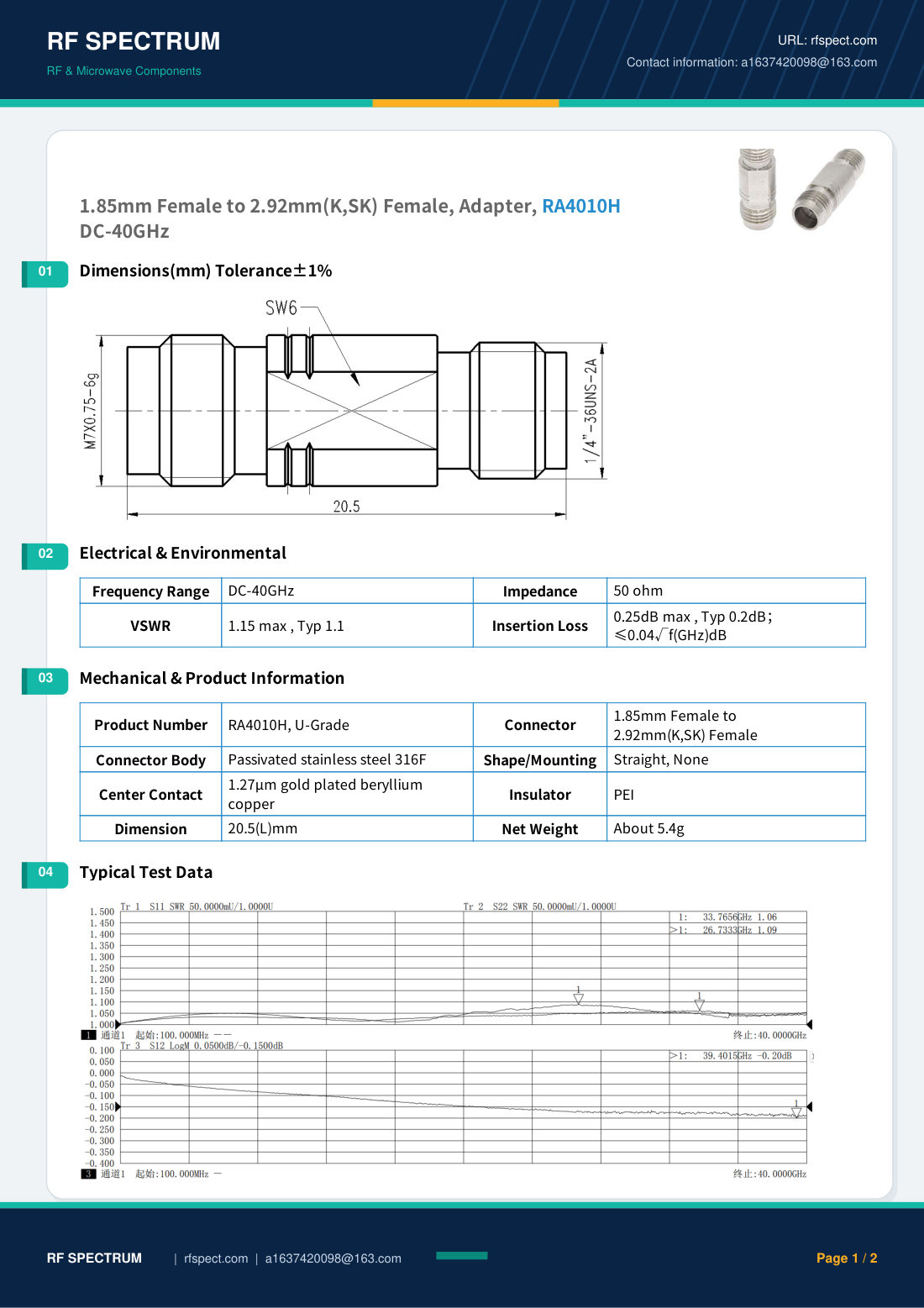
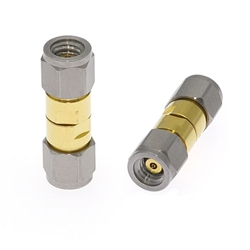
RA4010H is the Ultra-grade adapter for the 1.85mm female to 2.92mm female transition: straight body, 40 GHz rating, 50 ohm. The headline figures are a VSWR of 1.15:1 maximum and an insertion loss of 0.25 dB, all specified across the full DC to 40 GHz band rather than at spot frequencies. With a socket at each end, this part mates two male connectors, which is what a cable-to-cable run needs. The body is machined in one piece for this interface pair, so the centre contact stays concentric and the match does not depend on how two separate adapters happen to line up. The straight body keeps the run axial, which is the lowest-loss, lowest-stress way to join two ports. It is built in the Ultra tier, the tightest tolerance class of this interface family, intended for daily precision work.
Specifications
- Interface A: 1.85mm female
- Interface B: 2.92mm female
- Frequency: DC to 40 GHz
- Impedance: 50 ohm
- VSWR: 1.15:1 maximum
- Insertion loss: 0.25 dB maximum
- Body: stainless steel
- Weight: 0.03 kg
- Grade: Ultra
Where it is used
Production fixtures rely on it where a panel-mounted port has to meet a cable of another series, day after day. Test racks use it to bring a device under test onto an analyser without rebuilding the cable run for every new product.
The adapter is also the sacrificial part in a wear path: replace it when the match drifts instead of replacing the instrument port.
DC to 40 GHz is Ka-band territory: the wavelength is around 7 mm, so every mating plane and every bend counts as part of the circuit.
Compatibility and mating
1.85mm (V) mates 2.4mm and other 1.85mm parts, and nothing below that: SMA and 2.92mm look similar but will not mate correctly. Torque to about 0.9 N·m and keep the mating plane spotless.
The two series are not the same interface, so the part is the only place they meet: do not try to force a cable of one series onto the other end.
Keep the mating faces clean and dry, and inspect them under a loupe before a critical measurement; most ‘bad’ adapters are dirty ones.
Ordering
The SKU is the order code. If you need a different interface pair, a different gender combination or a longer body, ask before ordering rather than adapting this part on site.
Frequently asked questions
How many mating cycles will it take?
Precision interfaces are usually rated in the hundreds to a thousand cycles, and the exact figure is in the datasheet. Wear shows first as a rise in return loss.
Does an adapter add loss?
Yes, a small amount. The datasheet gives the maximum insertion loss for this part; at these frequencies it is usually a few tenths of a dB, but it belongs in the budget.
Can I mate it with a different precision series?
Only where the standards are mechanically compatible. SMA, 3.5mm and 2.92mm intermate; 2.4mm and 1.85mm intermate; mixing across those two groups damages the precision side.
What torque should I use?
About 0.9 N·m for SMA, 2.92mm and 2.4mm interfaces, 1.1 to 1.5 N·m for N. A torque wrench is cheap compared with a damaged calibration port.
Why does the price differ from a standard adapter?
Precision tiers hold tighter tolerances and use better materials and plating, which costs more to machine and to test. The tier is part of the part number, not an option.


Reviews
There are no reviews yet.