
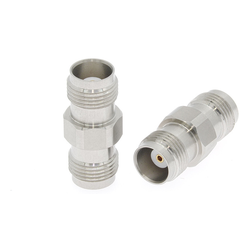

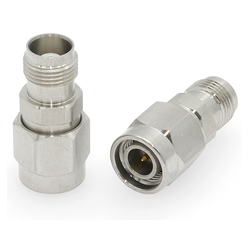

Attenuator
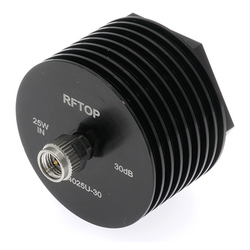
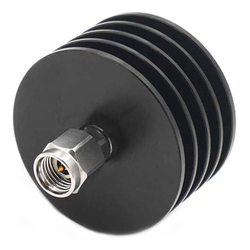
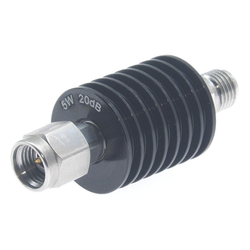
The attenuator catalogue holds 308 parts across 14 connector series, from 2 W in-line pads to 500 W high-power bodies, covering DC to 110 GHz. Fixed pads, push-button variable units and connectorised high-power attenuators are all listed under the same structure, so a level can be set the same way at 3 GHz and at 40 GHz.
The big families are N Attenuator, SMA Attenuator, 2.92mm Attenuator, BNC Attenuator and 4.3-10 Attenuator. Fixed coaxial pads dominate the volume; variable units are used where the level has to be trimmed between runs rather than fixed at design time. Power handling, not frequency, is usually what decides which body you end up with: a 2 W pad and a 100 W pad do the same electrical job in very different packages.
• Frequency: DC to 110 GHz depending on series
• Impedance: 50 Ω nominal
• Attenuation: standard windows from 1-30 dB up to 1-60 dB and 6-60 dB, ordered by value inside the window
• Power: 0.5 W in-line parts to 500 W heatsink bodies
• Types: fixed coaxial pads, push-button variable units, bidirectional and unidirectional bodies
• Interface: SMA, N, BNC, TNC, 2.92 mm, 2.4 mm, 1.85 mm, 1.0 mm, 4.3-10, 7/16, QMA and SSMA
Attenuators protect sensitive inputs, level sources, and set a known loss in a calibration path. Choose the attenuation from the level difference you need, the power from what the pad will actually absorb, and the series from the highest frequency in the set-up. A pad running near its power limit drifts, so leave thermal headroom.
Frequently asked questions
Fixed or variable attenuator?
Fixed pads set a level permanently and hold it accurately. Variable and push-button units trim the level live but specify a wider tolerance. If the level only changes between test set-ups, a fixed pad plus a switched path is usually cheaper and more repeatable.
How much power can an attenuator take?
The catalogue runs from 0.5 W in-line parts to 500 W heatsink bodies. Power rating is thermal, so an enclosed rack or a hot ambient reduces it — derate rather than run at the limit.
What attenuation values are standard?
Windows such as 1-30 dB, 1-40 dB, 1-50 dB and 6-60 dB, ordered in 1 dB steps inside the window. Non-standard values can usually be built to order.
See also N Attenuator, SMA Attenuator, 2.92mm Attenuator, BNC Attenuator and RF adapter.
Showing 1–40 of 308 results