
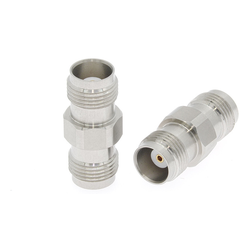

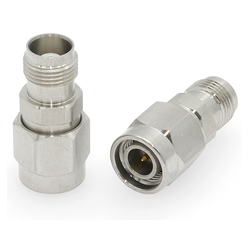

QN coaxial load
QN coaxial loads absorb forward power into 50 Ω DC to 6 GHz. One terminations are listed, from small in-line bodies to heatsink units rated 2 W.
Construction follows power: an in-line cylinder for a few watts, a finned body for tens of watts, and a heavy rectangular block where the load has to sit in a rack for hours. The joint is QN snap-lock on every part.
• Frequency: DC to 6 GHz
• Impedance: 50 Ω nominal
• Power: 2 W
• Interface: QN snap-lock
• Gender: male versions
• Body / plating: ternary-alloy plated brass bodies
They turn up on spare ports of a power divider, at the output of a combiner, and on the end of a line during a return-loss sweep. Heat is the limit: a 100 W load in still air inside a closed rack will not hold 100 W.
Frequently asked questions
How do I size a QN load?
Start from the highest average power the port will deliver, then add margin for reflected power and for the mounting. The listed range runs 2 W; above that, a heatsink body or forced air is needed rather than a small in-line part.
Does mounting orientation matter for a high-power load?
It does. Heatsink loads are designed to convect in a particular orientation, usually with the fins vertical. Mounting one upside down or burying it behind a panel cuts its dissipation well below the nameplate figure.
What is the difference between a coaxial load and a termination?
They are the same component. ‘Load’, ‘termination’ and ‘dummy load’ all refer to a 50 Ω resistor packaged in a connector body so a port can be left matched while absorbing the power sent to it.
See also N Coaxial Load, SMA Coaxial Load, TNC Coaxial Load, 2.92mm Coaxial Load and Load overview.
Showing the single result
