
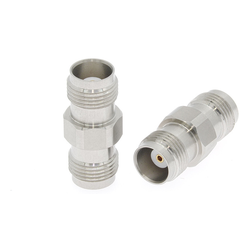

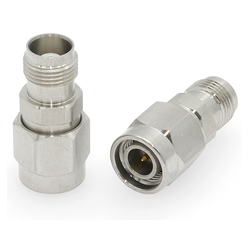

NH Adapter
These ten HN adapters keep a 50 Ω line intact DC to 3 GHz, moving HN onto L29 and N without adding a cable and a second junction.
The mating interface is HN high-voltage threaded — the high-voltage variant of the N interface. Because each part is machined as a single body rather than assembled from a connector plus a barrel, the centre pin stays concentric under torque and VSWR stays low across the band.
• Frequency: DC to 3 GHz
• Impedance: 50 Ω nominal
• Interface: HN high-voltage threaded
• Transitions: HN to L29 and N
• Gender: male-to-female, male-to-male and female-to-female
• Body / plating: nickel-plated brass and tri-metal plated brass bodies
• Grades stocked: Economy
Typical work is a test bench that has to move between HN and N and 7/16: instrument ports, DUT fixtures, and cable assemblies already terminated in another series. Match the grade to the job — Precision and Ultra parts for calibration and millimeter-wave measurements, Economy parts for production patching.
Frequently asked questions
What frequency range do HN adapters cover?
DC to 3 GHz. The ceiling is set by the HN interface, so an HN-to-HN body reaches the full rating while a transition to a lower-frequency series is limited by the weaker of the two interfaces.
Can an HN adapter be used in either direction?
Yes. An adapter is a passive reciprocal two-port, so it works the same way round; only the connector genders decide which end goes where. An HN line does not care which side the signal arrives from.
Which gender combination do I need?
The part has to be the mirror of the two ports. If both are the same gender you need the opposite body on both ends; if they differ, take the male-to-female version. The gender is in the product name, not in the option list.
See also N Adapter, L29 Adapter, SMA Adapter, Low-intermod Adapter and RF adapter overview.
Showing all 10 results


