
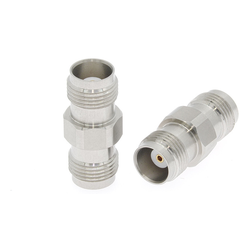

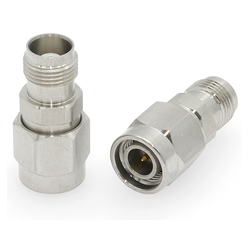

QSSMA Adapter
These one QSSMA adapters keep a 50 Ω line intact DC to 18 GHz, moving QSSMA onto SMA without adding a cable and a second junction.
Every part uses a QSSMA snap-lock joint, the tool-free SSMA replacement, and is built as one 50 Ω assembly. That matters on a bench: a two-piece lash-up adds a junction, and a junction adds reflection exactly where the measurement is most sensitive.
• Frequency: DC to 18 GHz
• Impedance: 50 Ω nominal
• Interface: QSSMA snap-lock
• Transitions: QSSMA to SMA
• Gender: male-to-female
• Body / plating: gold-plated beryllium copper and passivated stainless steel bodies
• Grades stocked: Ultra
Typical work is a test bench that has to move between QSSMA and SSMA: instrument ports, DUT fixtures, and cable assemblies already terminated in another series. Match the grade to the job — Precision and Ultra parts for calibration and millimeter-wave measurements, Economy parts for production patching.
Frequently asked questions
Which gender combination do I need?
The part has to be the mirror of the two ports. If both are the same gender you need the opposite body on both ends; if they differ, take the male-to-female version. The gender is in the product name, not in the option list.
How do I choose between Precision, Ultra and Economy grades?
Grade tracks mechanical tolerance, not interface type. Take Precision or Ultra when the adapter sits in a calibration path or above 26 GHz, and Economy when it is there to save a connector from wear on a production line.
Will an adapter damage a mismatched port?
No. The risk is mechanical, not electrical: repeatedly mating an adapter with a worn or dirty interface is what wears a port out, which is why a sacrificial adapter on an instrument is cheaper than a repair.
See also SMA Adapter, N Adapter, 2.92mm Adapter, 3.5mm Adapter and RF adapter overview.
Showing the single result
