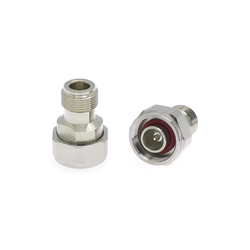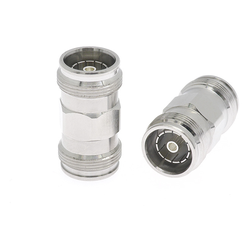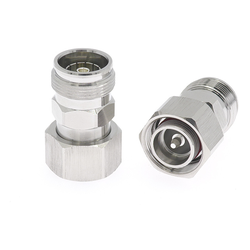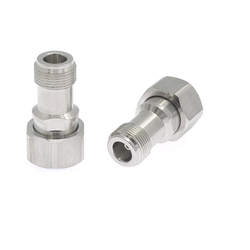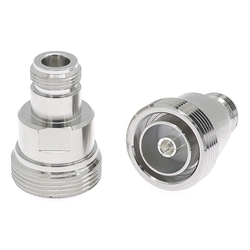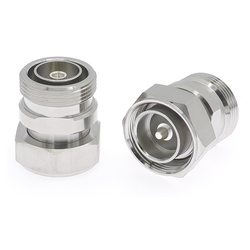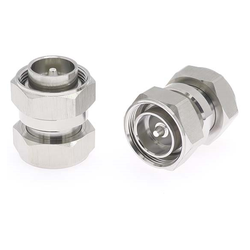

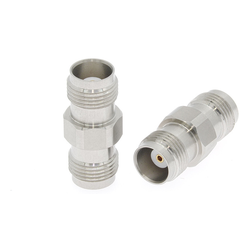

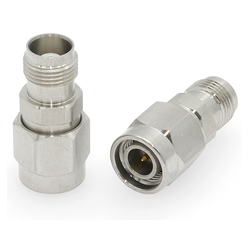

Low-intermod Adapter
These 24 NEX10 adapters keep a 50 Ω line intact DC to 6 GHz, moving NEX10 onto N, L29, 4.3-10 and 3.5mm without adding a cable and a second junction.
Mechanically these are NEX10 push-pull on the NEX10 side, the compact low-PIM interface for dense installations. The bodies are single-piece, so the adapter can be tightened onto an instrument port without the centre contact rotating with it.
• Frequency: DC to 6 GHz
• Impedance: 50 Ω nominal
• Interface: NEX10 push-pull
• Transitions: NEX10 to N, L29, 4.3-10 and 3.5mm
• Gender: male-to-female, male-to-male and female-to-female
• Body / plating: tri-metal plated brass and ternary-alloy plated brass bodies
• Grades stocked: Precision
Use them to protect an instrument port from repeated mating, to convert a fixture to the connector the DUT actually has, or to join two cables of different series. The grade should follow the tolerance the measurement needs, not the price of the part.
Frequently asked questions
How do I choose between Precision, Ultra and Economy grades?
Grade tracks mechanical tolerance, not interface type. Take Precision or Ultra when the adapter sits in a calibration path or above 26 GHz, and Economy when it is there to save a connector from wear on a production line.
What frequency range do NEX10 adapters cover?
DC to 6 GHz. The ceiling is set by the NEX10 interface, so an NEX10-to-NEX10 body reaches the full rating while a transition to a lower-frequency series is limited by the weaker of the two interfaces.
Will an adapter damage a mismatched port?
No. The risk is mechanical, not electrical: repeatedly mating an adapter with a worn or dirty interface is what wears a port out, which is why a sacrificial adapter on an instrument is cheaper than a repair.
See also SMA Adapter, N Adapter, 2.92mm Adapter, 3.5mm Adapter and RF adapter overview.
Showing all 13 results
-
4.1-9.5 Male to N Female Adapter | Precision, Low PIM, DC-6GHz, Brass with Tri-metal Plating
Low-intermod Adapter $51.00 -
4.3-10 Female to 4.3-10 Female Adapter | Precision, Low PIM, DC-6GHz, Brass with Tri-metal Plating
Low-intermod Adapter $60.00 -
4.3-10 Male to 4.3-10 Female Adapter | Precision, Low PIM, DC-6GHz, Brass with Tri-metal Plating
Low-intermod Adapter $60.00 -
4.3-10 Male to N Female Adapter | Precision, Low PIM, DC-6GHz, Brass with Tri-metal Plating
Low-intermod Adapter $60.00 -
4.3-10 Male to N Male Adapter | Precision, Low PIM, DC-6GHz, Brass with Tri-metal Plating
Low-intermod Adapter $60.00 -
L29 (DIN 7/16) Female to 4.3-10 Male Adapter | Precision, Low PIM, DC-6GHz, Brass with Tri-metal Plating
Low-intermod Adapter $69.00 -
L29 (DIN 7/16) Female to N Female Adapter | Precision, Low PIM, DC-6GHz, Brass with Tri-metal Plating
Low-intermod Adapter $55.00 -
L29 (DIN 7/16) Female to N Male Adapter | Precision, Low PIM, DC-6GHz, Brass with Tri-metal Plating
Low-intermod Adapter $55.00 -
L29 (DIN 7/16) Male to L29 (DIN 7/16) Female Adapter | Precision, Low PIM, DC-6GHz, Brass with Tri-metal Plating
Low-intermod Adapter $65.00 -
L29 (DIN 7/16) Male to L29 (DIN 7/16) Male Adapter | Precision, Low PIM, DC-6GHz, Brass with Tri-metal Plating
Low-intermod Adapter $65.00 -
L29 (DIN 7/16) Male to N Female Adapter | Precision, Low PIM, DC-6GHz, Brass with Tri-metal Plating
Low-intermod Adapter $55.00 -
L29 (DIN 7/16) Male to N Male Adapter | Precision, Low PIM, DC-6GHz, Brass with Tri-metal Plating
Low-intermod Adapter $55.00