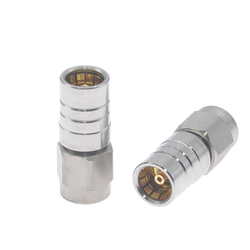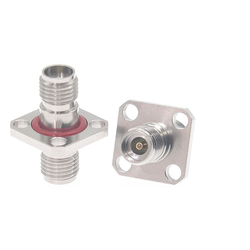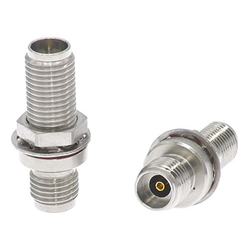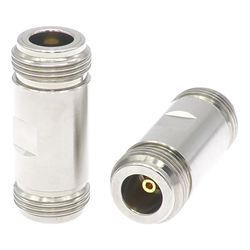

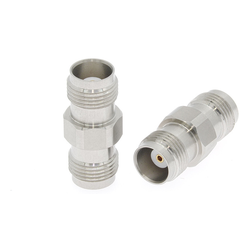

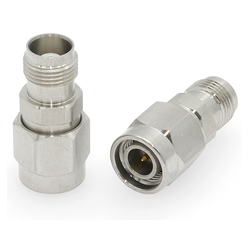

RF adapter
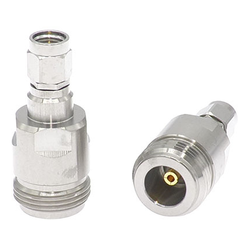
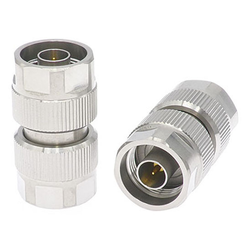
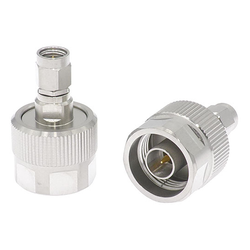
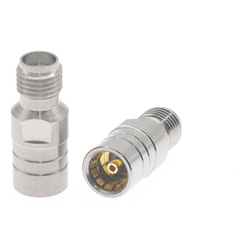
RFSPECT stocks 664 coaxial adapters across 32 connector series, from SMA and N bodies used on every bench to 1.0 mm parts specified to 110 GHz. Every item here is a 50 Ω, single-piece transition: no cable in between, no second junction, and no change in interface geometry from one port to the other.
The catalogue is organised by series rather than by part number, because the series is what decides the frequency ceiling. Heavyweights are SMA Adapter, N Adapter, 2.92mm Adapter, 3.5mm Adapter and 2.4mm Adapter; below them the millimeter-wave families (3.5 mm, 2.92 mm, 2.4 mm, 1.85 mm, 1.0 mm) run in the same pattern, and the low-PIM series (4.3-10, NEX10, 7/16) sit alongside for cellular work.
• Frequency coverage: 3 GHz on UHF, 4 GHz on BNC, 11 GHz on TNC, 18 GHz on SMA and N, 40 GHz on 2.92 mm, 50 GHz on 2.4 mm, 67 GHz on 1.85 mm, 110 GHz on 1.0 mm
• Impedance: 50 Ω, with 75 Ω matching pads in the impedance adapter series
• Series stocked: 32 — SMA, N, BNC, TNC, 3.5 mm, 2.92 mm, 2.4 mm, 1.85 mm, 1.0 mm, SMP, SSMP, 4.3-10, 7/16 and more
• Gender: male-to-female, male-to-male and female-to-female in every main series
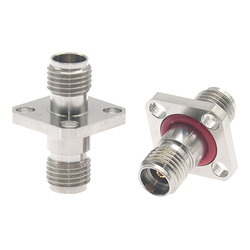
• Body styles: straight, right angle 90°, 2-hole and 4-hole flange, bulkhead
• Grades: Precision, Ultra, Professional and Economy
Use the series table to narrow the choice: take the highest frequency any port in the set-up will see, and pick the series that just covers it — a 2.92 mm adapter used at 18 GHz costs more than an SMA one and buys nothing. Adapters are also the cheapest way to protect an instrument port: a sacrificial adapter on a VNA front panel takes the wear instead of the connector inside the instrument.
Frequently asked questions
How do I know which adapter series I need?
Start from the highest frequency in the measurement. SMA covers most work to 18 GHz, 2.92 mm (K) to 40 GHz, 2.4 mm to 50 GHz, 1.85 mm to 67 GHz and 1.0 mm to 110 GHz. Adapters may only mate with series of the same or smaller geometry — SMA can meet 3.5 mm and 2.92 mm, but never 2.4 mm.
Are adapters available in both gender combinations?
Yes. Within each series the catalogue carries male-to-male, female-to-female and male-to-female bodies, plus right-angle and flange versions where the interface allows.
What does ‘precision’ mean on an adapter?
It refers to mechanical tolerance: concentricity, pin depth and the surface finish of the mating plane. A precision adapter holds a tighter VSWR and a more repeatable connection, which matters inside a calibration path and much less on a production line.
See also SMA Adapter, N Adapter, 2.92mm Adapter, 3.5mm Adapter and Load.
Further reading: SMA vs 2.92mm vs 2.4mm vs 1.85mm — how to choose the right precision RF connector.
Showing 1–40 of 664 results
-
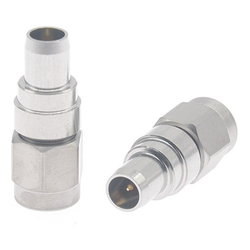
1.0mm Female to 1.0mm Male Millimeter Wave Adapter Precision Type, DC-110GHz, Stainless Steel with Gold-Plated Beryllium Copper – RA11002
1.0mm Adapter Original price was: $150.00.$130.00Current price is: $130.00. -
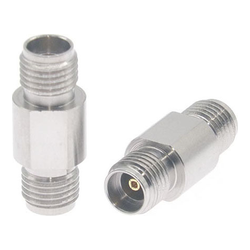
1.0mm Female to 1.0mm Male Millimeter Wave Adapter Ultra, DC-110GHz, Stainless Steel – RA11002H
1.0mm Adapter Original price was: $150.00.$120.00Current price is: $120.00.