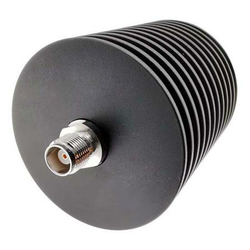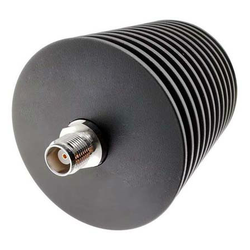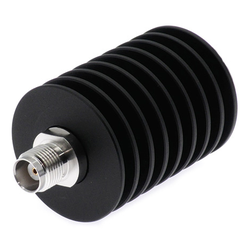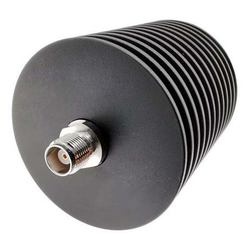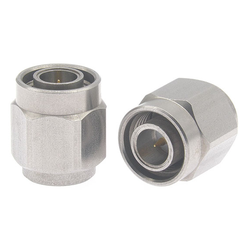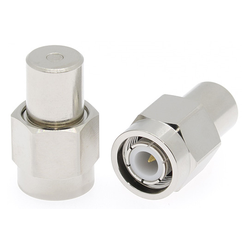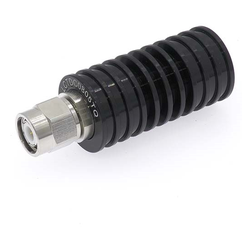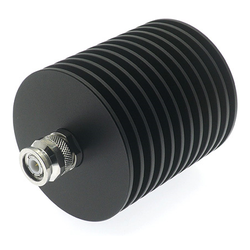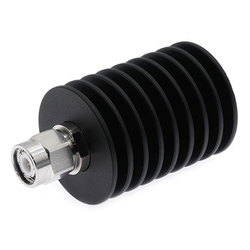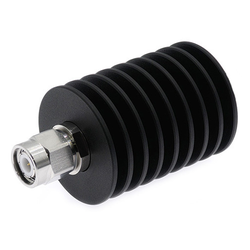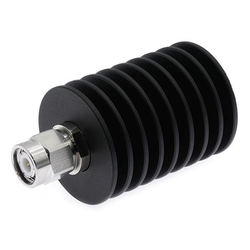

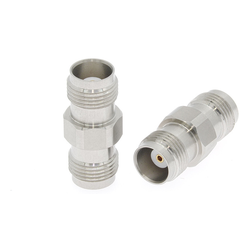

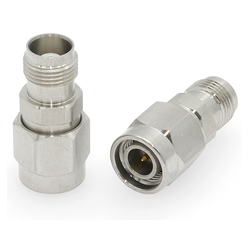

TNC Coaxial Load
A 50 Ω termination is the only way to leave a TNC port matched when nothing is connected to it. This range holds 27 loads, DC to 18 GHz, 2 W to 50 W of dissipation.
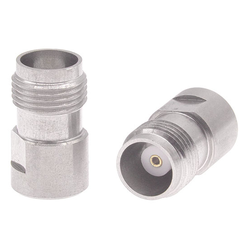
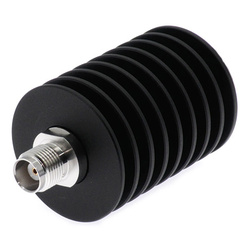
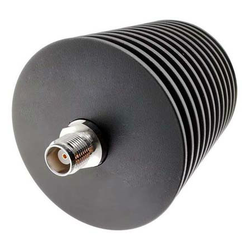
Construction follows power: an in-line cylinder for a few watts, a finned body for tens of watts, and a heavy rectangular block where the load has to sit in a rack for hours. The joint is 7/16-28 threaded on every part.
• Frequency: DC to 18 GHz
• Impedance: 50 Ω nominal
• Power: 2 W to 50 W
• Interface: 7/16-28 threaded
• Gender: male and female versions
• Body / plating: passivated stainless steel, nickel-plated brass and ternary-alloy plated brass bodies
• Options: medium-power, high-power and anti-pulse bodies
Loads terminate unused ports on a divider or switch, absorb power at the end of a test line, and protect a source from running into an open circuit. Size the body from average power with margin for pulse duty and for the way it is mounted.
Frequently asked questions
Does a load need a heatsink or airflow?
Above a few watts, yes. In-line bodies rely on free convection, so mounting them against a panel, inside a closed rack or in a hot ambient reduces the rating. High-power loads are built around a heatsink for exactly that reason.
Can a load be used to measure power?
No. A load absorbs power, it does not measure it. Measurement needs a power sensor, or a load plus a directional coupler and a calibrated sensor.
How do I size a TNC load?
Start from the highest average power the port will deliver, then add margin for reflected power and for the mounting. The listed range runs 2 W to 50 W; above that, a heatsink body or forced air is needed rather than a small in-line part.
See also TNC attenuators, N Coaxial Load, SMA Coaxial Load, 2.92mm Coaxial Load and 4.3-10 Coaxial Load.
Showing all 27 results