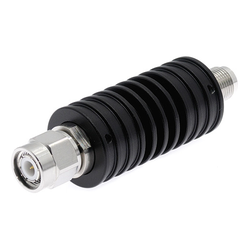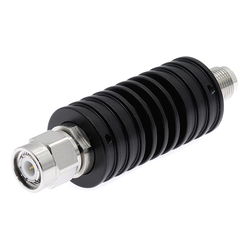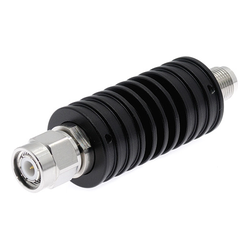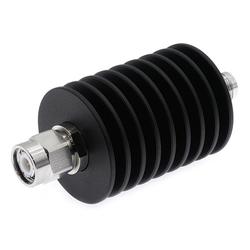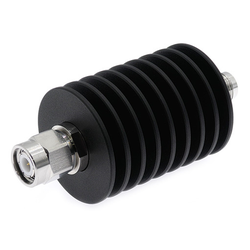

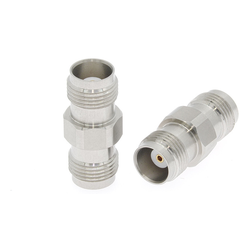

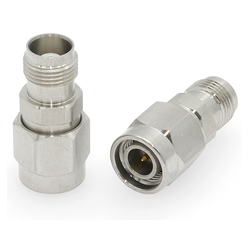

TNC Attenuator
TNC attenuators drop a signal to a level the next stage can take, without changing the impedance. Nine parts are listed here, 50 Ω throughout, DC to 6 GHz, with variants specified to 18 GHz, rated 5 W to 20 W.
Fixed pads are sold as attenuation windows — a 1-40 dB part is ordered in the value you need inside that window — while variable and push-button units cover a continuous span in defined steps. That split is the real choice here: a fixed pad sets a level once, a variable one trims it during the test.
• Frequency: DC to 6 GHz, with variants specified to 18 GHz
• Impedance: 50 Ω nominal
• Interface: 7/16-28 threaded
• Power: 5 W to 20 W
• Attenuation: 1-40 dB, 1-60 dB, 6-50 dB
• Types: fixed coaxial pads, bidirectional and unidirectional bodies
• Body / plating: tri-metal plated brass bodies
These pads protect a spectrum analyser input, level a source, or build a known loss into a calibration path. Size the pad from the power it will actually absorb rather than the source rating — a pad running hot drifts, and its accuracy figure no longer applies.
Frequently asked questions
Does the attenuation value change the VSWR?
Slightly. A high-value pad is almost entirely resistive, so it presents a very good match in both directions. Low-value pads show more of the connector’s own mismatch, which is one reason a 3 dB pad is a poor choice as a matching device.
What attenuation values are available?
Fixed pads are listed in windows such as 1-40 dB, 1-60 dB, 6-50 dB. Values are ordered inside the window; anything outside it can usually be built to order, so ask before assuming the range stops there.
Can two pads be cascaded for more attenuation?
Yes, and the losses add in dB. Keep the total within what the system can tolerate, and remember that the second pad sees a lower power level, so its rating can often be smaller than the first.
See also TNC coaxial loads, N Attenuator, SMA Attenuator, 2.92mm Attenuator and BNC Attenuator.
Showing all 9 results