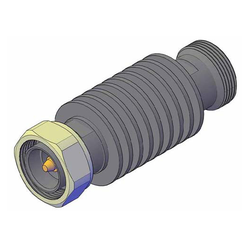

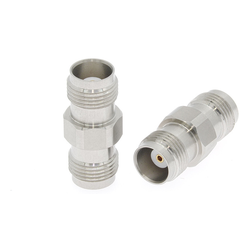

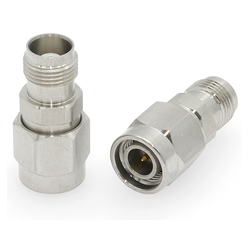

L29 Attenuator
Pad an L29 line down where it needs it: two L29 attenuators, all 50 Ω, DC to 4 GHz, with variants specified to 6 GHz, spanning bodies rated 10 W.
Attenuation is quoted as a window rather than a single value, because the same body is built in a series of values. Fixed pads suit a level that never changes; push-button and rotary parts suit a bench where the level is adjusted between runs.
• Frequency: DC to 4 GHz, with variants specified to 6 GHz
• Impedance: 50 Ω nominal
• Interface: DIN 7/16 threaded
• Power: 10 W
• Attenuation: 1-60 dB
• Types: fixed coaxial pads, bidirectional and unidirectional bodies
• Body / plating: tri-metal plated brass bodies
Typical jobs are receiver protection, source levelling, and padding a link so both ends sit in the same power window. The frequency rating is a ceiling, not a suggestion: a part specified DC to 4 GHz, with variants specified to 6 GHz holds its accuracy inside that band and loses it above.
Frequently asked questions
What attenuation values are available?
Fixed pads are listed in windows such as 1-60 dB. Values are ordered inside the window; anything outside it can usually be built to order, so ask before assuming the range stops there.
Does the attenuation value change the VSWR?
Slightly. A high-value pad is almost entirely resistive, so it presents a very good match in both directions. Low-value pads show more of the connector’s own mismatch, which is one reason a 3 dB pad is a poor choice as a matching device.
Should I choose bidirectional or unidirectional?
A bidirectional pad works in either direction and is the normal bench choice. A unidirectional body defines input and output, which is what you want when reverse power has to be blocked or when connector genders force a direction.
See also L29 coaxial loads, N Attenuator, SMA Attenuator, 2.92mm Attenuator and BNC Attenuator.
Showing all 2 results