
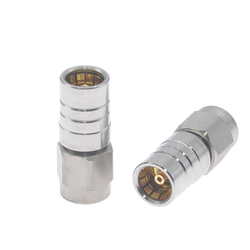
RA18S36 carries a [Best Value] SMA male interface on one end and a BMA female interface on the other, in a single straight housing specified to 18 GHz.
One end is a male [Best Value] SMA interface, the other a female BMA interface — the two sexes differ, so match each end against the cable or port it has to meet.
The straight body keeps the run axial, which is the shortest electrical path and the lowest-loss layout when the chassis has room. Common applications are test fixtures, instrument front panels and module-to-module links inside an enclosure.
DC–18 GHz covers the great majority of SMA lab work, from baseband through Ku-band. The passivated stainless body resists wear and corrosion on repeatedly mated parts, and holds its dimensions over thousands of cycles.
Key numbers: VSWR 1.2:1 max; 50 Ω impedance; passivated stainless steel body.
The [Best Value] SMA end and the BMA end both follow their usual interface standards; no proprietary tooling is needed.
FAQ — Is it bidirectional? Yes. An adapter is a passive two-port, so it works in either direction; the only asymmetry is mechanical, in how it mounts.


Reviews
There are no reviews yet.