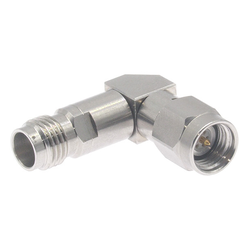
A ultra-grade body, two interfaces, one job: RA4007WH02 carries 2.4mm Female on one end and 2.92mm(K,SK) Male on the other, to 40 GHz.
Specifications
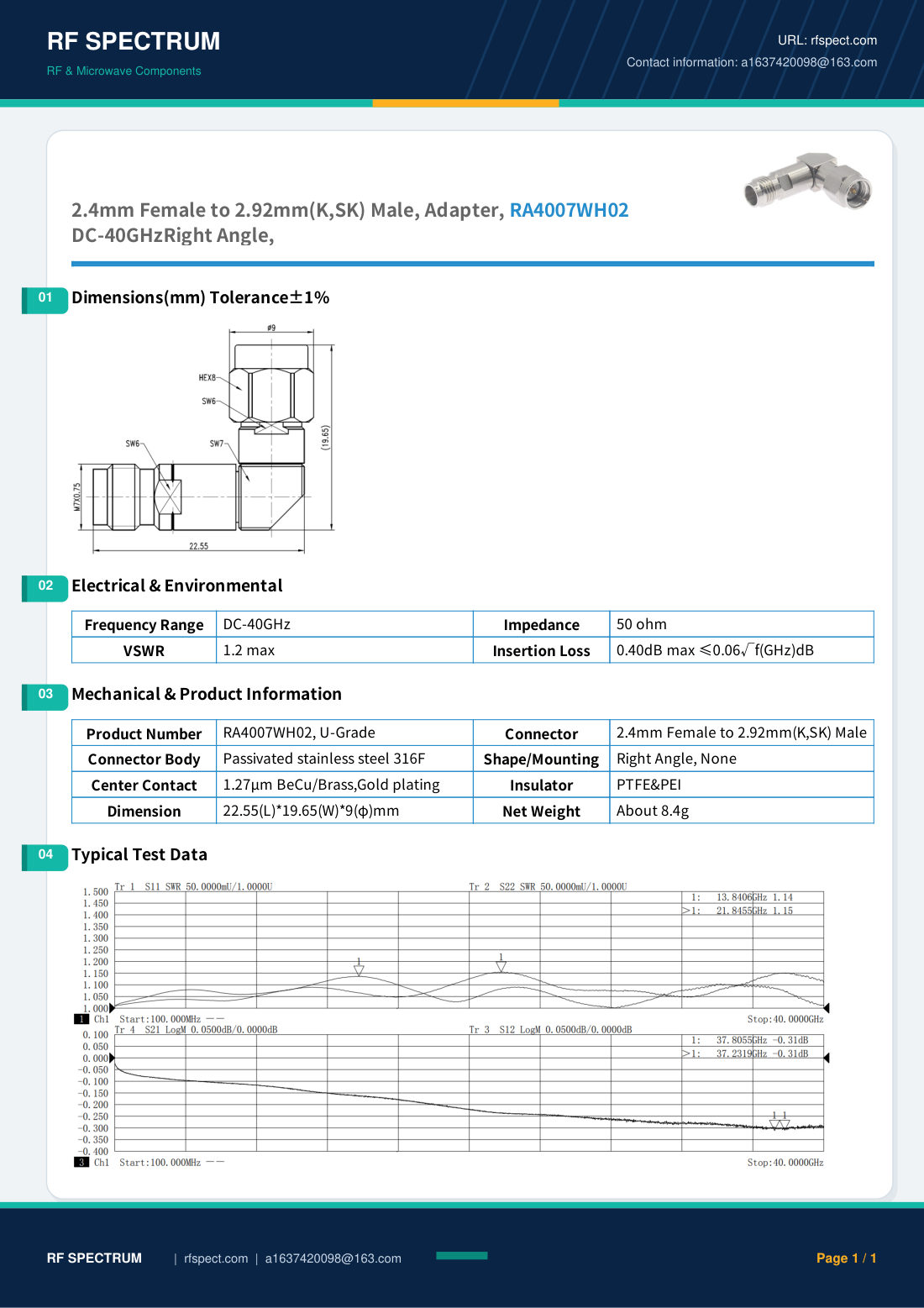
- Frequency: DC to 40 GHz
- Impedance: 50 Ω
- VSWR: 1.2:1 max
- Insertion loss: 0.40 dB max
- Interfaces: 2.4mm Female / 2.92mm(K,SK) Male
- Body and contact: Stainless Steel
- Grade: Ultra
Typical application
On a probe station or in an antenna range the adapter is the last mechanical interface before the device, so its body length and its torque window both matter as much as the VSWR figure printed on the datasheet. One jack and one plug, in that order. The jack is the end that takes a cable plug, the plug is the end that goes into a fixed port; if the fixture is wired the other way round the adapter will not seat, and forcing it is how a centre contact gets pushed back.
What it mates with
2.92mm (K) mates with SMA and 3.5mm as well as with itself, and it is the usual way to reach 40 GHz without changing the SMA thread. 2.4mm is the interface most 50 GHz instruments carry, and its air line is the reason it refuses an SMA thread. Two parts worth comparing are 2.4mm Female to 2.4mm Female 4-Hole Flange Millimeter-Wave Adapter (RA5001FH) and 2.4mm Female to 2.4mm Female Millimeter-Wave Adapter (RA5001H) — same interface family, different grade or body style, so the choice usually comes down to the frequency headroom you need rather than to the price.
A common question
Can this adapter be used below its rated frequency?
Yes, and it will generally measure better there. Running a millimetre-wave adapter at a lower band is harmless; the reverse — running a low-band part near its cutoff — is where the match and the repeatability fall apart.


Reviews
There are no reviews yet.