
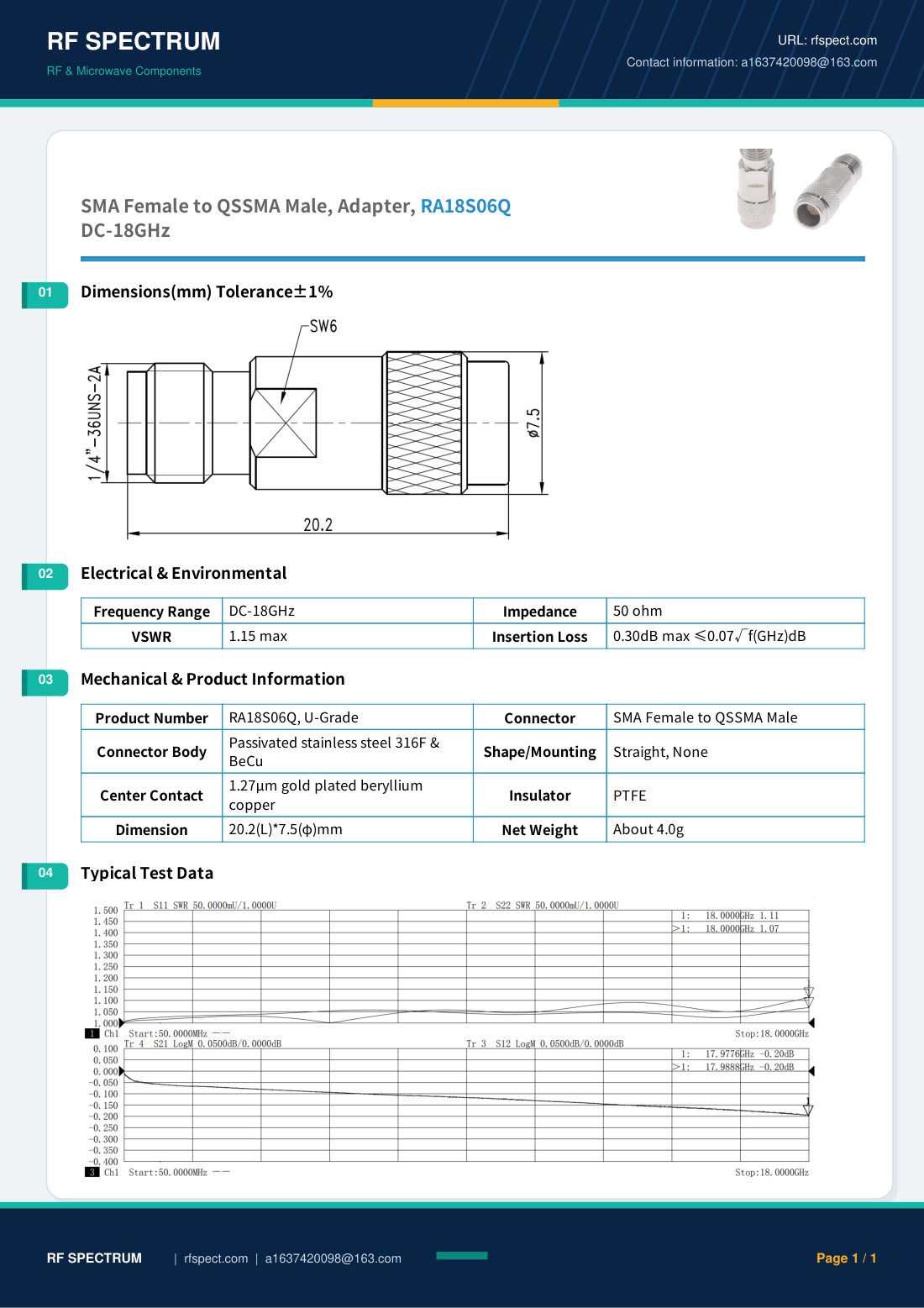
In one straight housing, RA18S06Q converts SMA female into QSSMA male across the DC-18 GHz band. The headline figures are a VSWR of 1.15:1 maximum and an insertion loss of 0.30 dB, all specified across the full DC to 18 GHz band rather than at spot frequencies. One end is male and the other female, so the direction is fixed: the pin goes into the port that expects it, and the part cannot be reversed. The body is machined in one piece for this interface pair, so the centre contact stays concentric and the match does not depend on how two separate adapters happen to line up. The straight body keeps the run axial, which is the lowest-loss, lowest-stress way to join two ports. It is built in the Ultra tier, the tightest tolerance class of this interface family, intended for daily precision work.
Specifications
- Interface A: SMA female
- Interface B: QSSMA male
- Frequency: DC to 18 GHz
- Impedance: 50 ohm
- VSWR: 1.15:1 maximum
- Insertion loss: 0.30 dB maximum
- Body: stainless steel
- Weight: 0.03 kg
- Grade: Ultra
Where it is used
It also earns its place in system integration, where two sub-assemblies with different connectors have to be joined without a custom cable. Field kits carry it because one adapter covers the mismatch between whatever the site has and whatever the instrument expects.
It is a passive part with no tuning, so it can be swapped in mid-project without re-characterising the rest of the chain.
Up to 18 GHz the connector is electrically small, which is why the same body works across the whole band without a tuning feature.
Compatibility and mating
Any standard SMA cable or port will mate it. Keep the mating faces clean and use the specified torque: a worn SMA pair shows up as a rise in return loss long before it fails outright.
Each end keeps its own interface standard, which is why the part number lists both series rather than a single connector type.
Do not use the body as a lever. Side load on a connected cable is what bends centre pins and opens the match.
Ordering
Order by the part number as listed: the code encodes the interface pair, the gender at each end and the body style, so a different suffix is a different part rather than a variant of this one.
Frequently asked questions
Can I mate it with a different precision series?
Only where the standards are mechanically compatible. SMA, 3.5mm and 2.92mm intermate; 2.4mm and 1.85mm intermate; mixing across those two groups damages the precision side.
What torque should I use?
About 0.9 N·m for SMA, 2.92mm and 2.4mm interfaces, 1.1 to 1.5 N·m for N. A torque wrench is cheap compared with a damaged calibration port.
Will it degrade my VSWR?
Every interface adds a reflection. The guaranteed maximum is in the specifications above, and a good adapter typically measures better than its limit on a calibrated analyser.
How many mating cycles will it take?
Precision interfaces are usually rated in the hundreds to a thousand cycles, and the exact figure is in the datasheet. Wear shows first as a rise in return loss.
Why does the price differ from a standard adapter?
Precision tiers hold tighter tolerances and use better materials and plating, which costs more to machine and to test. The tier is part of the part number, not an option.


Reviews
There are no reviews yet.