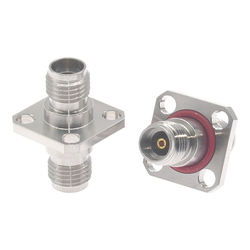
RA3401FSH carries a 3.5 mm female interface on one end and a second 3.5 mm female interface on the other, in a single four-hole flange housing specified to 34 GHz.
Both ends are female, so it joins two ports or cables of the same sex; the part number states the pairing.
Key numbers: VSWR 1.2:1 max; insertion loss 0.20 dB max (<= 0.04 sqrt-f GHz); 50 ohm impedance; passivated stainless steel body.
FAQ – Is it bidirectional? Yes. An adapter is a passive reciprocal two-port, so it works the same way round; only the mechanical mounting differs.
FAQ – What is the worst-case loss? The datasheet below lists maximum insertion loss; the 0.20 figure applies across the band.
The mating face carries an O-ring seal, so the interface stays dry when the panel sees splash or humidity.
The four-hole flange bolts the adapter rigidly to a chassis wall or fixture plate, so the interface cannot rotate while a cable is torqued onto it. Systems integrators use it at the boundaries between subsystems, where two vendors rarely agree on the same connector.
Up here the adapter is a precision part: alignment, concentricity and a clean mating plane matter more than the cable attached to it. The passivated stainless body holds its dimensions through thousands of mating cycles and resists corrosion on repeatedly handled parts.
FAQ – What torque should I use? Use the torque recommended for the interface standard of each end. Over-tightening is the usual cause of a damaged mating plane.



Reviews
There are no reviews yet.