
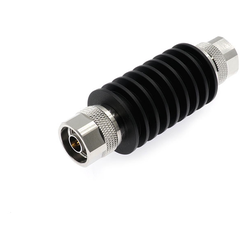
Rated 10 W and specified from DC to 6 GHz, R6N10MM-XX inserts 1-60 dB into a N line as a fixed pad.
A fixed pad trades flexibility for certainty: the value is what it says, every time, across the band.
Typical use is protecting a receiver or spectrum-analyser front end from an over-level signal, or setting a known level into a device under test.
FAQ – Can I cascade two pads? Yes, and the dB values add. Check that the first pad’s power rating covers the incoming level and that the second sees a lower power, which it will.
FAQ – What happens above 6 GHz? The attenuation accuracy and VSWR are specified to 6 GHz; beyond that the pad will still attenuate but no longer to the printed accuracy.
Either connector can face the source: the symmetric construction attenuates identically in both directions.
At 10 W of dissipation the body is sized to take continuous input at that level; the resistive element and its heat path are matched to it, which is why the rating is a hard number rather than a guideline.
The DC to 6 GHz range is the accuracy band: inside it the attenuation stays within the printed tolerance and the VSWR within its figure.
Key numbers: attenuation 1-60 dB; 10 W power; VSWR 1.2:1 max; 50 ohm impedance; tri-metal plated brass body.
FAQ – Will it change my VSWR? A fixed resistive pad actually improves the match seen by both sides, because the attenuating network absorbs reflections. The VSWR figure below is the number to design against.


Reviews
There are no reviews yet.