
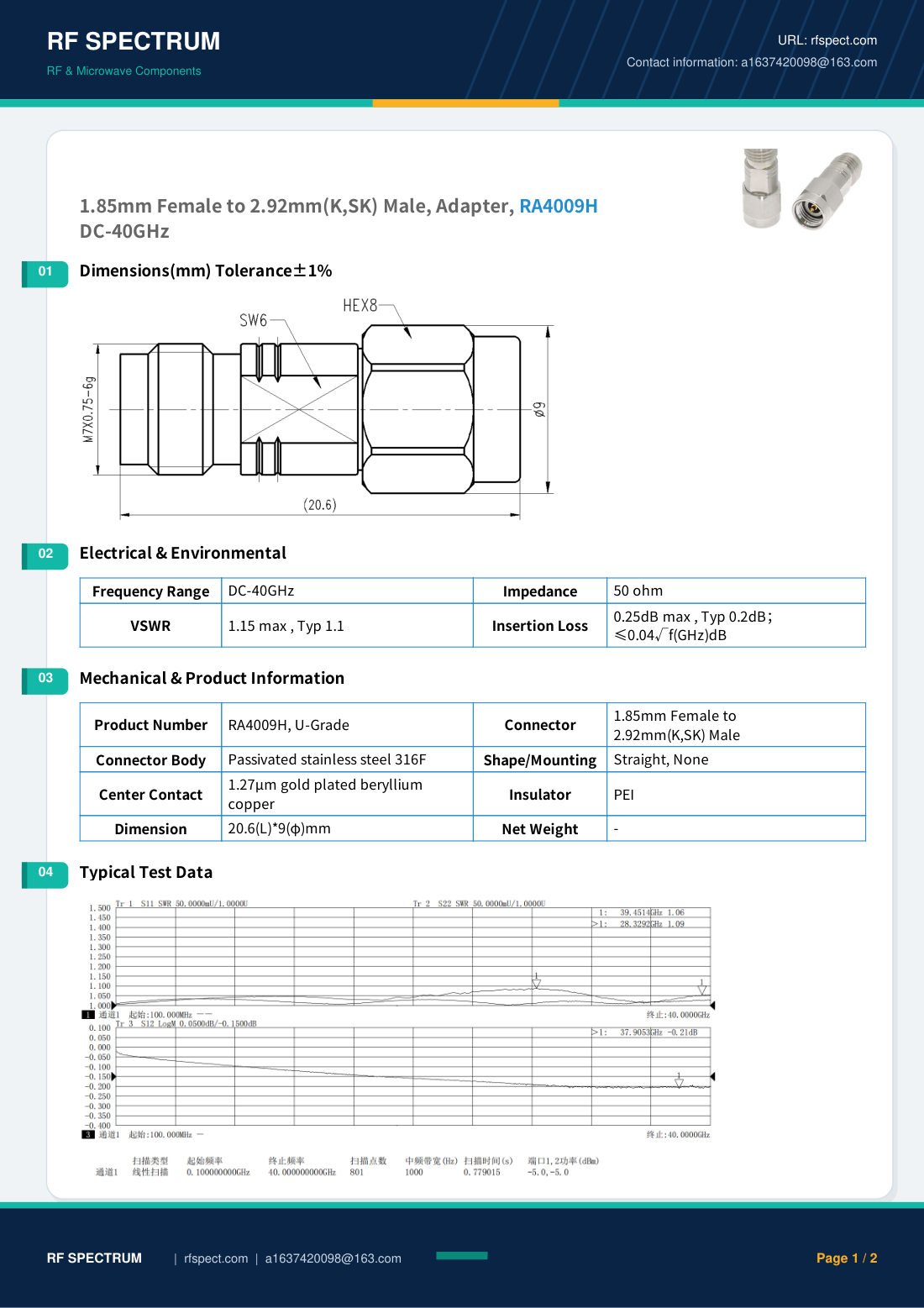
The RA4009H is a straight adapter that takes 1.85mm female and presents 2.92mm male on the other end, specified from DC to 40 GHz. The headline figures are a VSWR of 1.15:1 maximum and an insertion loss of 0.25 dB, all specified across the full DC to 40 GHz band rather than at spot frequencies. One end is male and the other female, so the direction is fixed: the pin goes into the port that expects it, and the part cannot be reversed. One-piece construction is the point: every extra mating plane is another reflection, and this part replaces a stack of them with a single joint. The straight body keeps the run axial, which is the lowest-loss, lowest-stress way to join two ports. It is built in the Ultra tier, the tightest tolerance class of this interface family, intended for daily precision work.
Specifications
- Interface A: 1.85mm female
- Interface B: 2.92mm male
- Frequency: DC to 40 GHz
- Impedance: 50 ohm
- VSWR: 1.15:1 maximum
- Insertion loss: 0.25 dB maximum
- Body: stainless steel
- Weight: 0.03 kg
- Grade: Ultra
Where it is used
Production fixtures rely on it where a panel-mounted port has to meet a cable of another series, day after day. Field kits carry it because one adapter covers the mismatch between whatever the site has and whatever the instrument expects.
The adapter is also the sacrificial part in a wear path: replace it when the match drifts instead of replacing the instrument port.
DC to 40 GHz is Ka-band territory: the wavelength is around 7 mm, so every mating plane and every bend counts as part of the circuit.
Compatibility and mating
1.85mm (V) mates 2.4mm and other 1.85mm parts, and nothing below that: SMA and 2.92mm look similar but will not mate correctly. Torque to about 0.9 N·m and keep the mating plane spotless.
The two series are not the same interface, so the part is the only place they meet: do not try to force a cable of one series onto the other end.
Check the interface with a gauge after any drop. A part that has been dropped usually looks fine and measures badly.
Ordering
The SKU is the order code. If you need a different interface pair, a different gender combination or a longer body, ask before ordering rather than adapting this part on site.
Frequently asked questions
Will it degrade my VSWR?
Every interface adds a reflection. The guaranteed maximum is in the specifications above, and a good adapter typically measures better than its limit on a calibrated analyser.
Can it be mounted to a panel?
Only if the body is a flange or bulkhead type. A straight in-line adapter is not designed to carry panel load; use the flanged version for that.
How many mating cycles will it take?
Precision interfaces are usually rated in the hundreds to a thousand cycles, and the exact figure is in the datasheet. Wear shows first as a rise in return loss.
Is it 50 or 75 ohm?
This part is 50 ohm. A 75 ohm system needs a matching pad or a 75 ohm part; the two impedances are not interchangeable on a threaded interface of the same size.
Does it work at DC?
Yes, it is a passive coaxial through-connection, so it passes DC as well as RF unless the datasheet says otherwise.


Reviews
There are no reviews yet.