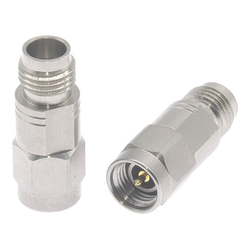
Two ports that do not match: that is the whole reason RA3417H exists. It converts 1.85mm Female to 3.5mm Male and stays usable to 34 GHz.
Electrical and mechanical
- Frequency: DC to 34 GHz
- Impedance: 50 Ω
- VSWR: 1.2:1 max
- Insertion loss: 0.20 dB max
- Interfaces: 1.85mm Female / 3.5mm Male
- Body and contact: Stainless Steel
- Grade: Ultra
Typical application
Fixtures that run the same measurement thousands of times put this part at the wear point: the adapter is swapped, the instrument port is not. That is also why the grade matters more here than in a one-off bench connection. One jack and one plug, in that order. The jack is the end that takes a cable plug, the plug is the end that goes into a fixed port; if the fixture is wired the other way round the adapter will not seat, and forcing it is how a centre contact gets pushed back.
Mating and compatibility
1.85mm (V) mates with 2.4mm and with itself. Treat it as a 67 GHz interface: below that it is chosen for repeatability rather than for reach. A 3.5mm port is where lab equipment sits: it is mechanically SMA-compatible, so an SMA cable will mate and only the frequency limit stops it. Two parts worth comparing are 1.85mm Male to 3.5mm Male Millimeter Wave Adapter (RA3416H) and 1.85mm Male to 3.5mm Female Millimeter Wave Adapter (RA3418H) — same interface family, different grade or body style, so the choice usually comes down to the frequency headroom you need rather than to the price.
A common question
Can this adapter be used below its rated frequency?
Yes, and it will generally measure better there. Running a millimetre-wave adapter at a lower band is harmless; the reverse — running a low-band part near its cutoff — is where the match and the repeatability fall apart.


Reviews
There are no reviews yet.