
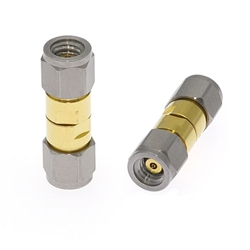
RA18AP04 is a passive straight adapter for the 2.92mm female-to-APC-7 transition, with the 50 ohm match held from DC to 18 GHz. The headline figures are a VSWR of 1.25:1 maximum and an insertion loss of 0.30 dB, all specified across the full DC to 18 GHz band rather than at spot frequencies. The gender at each end is stated in the part number; match it against the port or cable it has to meet before ordering. One-piece construction is the point: every extra mating plane is another reflection, and this part replaces a stack of them with a single joint. The straight body keeps the run axial, which is the lowest-loss, lowest-stress way to join two ports. It is built in the Economy tier, the value build, keeping the same interface dimensions at a lower price point.
Specifications
- Interface A: 2.92mm female
- Interface B: APC-7
- Frequency: DC to 18 GHz
- Impedance: 50 ohm
- VSWR: 1.25:1 maximum
- Insertion loss: 0.30 dB maximum
- Body: stainless steel
- Centre contact: gold-plated beryllium copper centre contact
- Weight: 0.03 kg
- Grade: Economy
Where it is used
Field kits carry it because one adapter covers the mismatch between whatever the site has and whatever the instrument expects. Test racks use it to bring a device under test onto an analyser without rebuilding the cable run for every new product.
It is a passive part with no tuning, so it can be swapped in mid-project without re-characterising the rest of the chain.
DC to 18 GHz covers most laboratory traffic, from baseband through the lower microwave bands, and it is the range where this interface family has the deepest catalogue.
Compatibility and mating
2.92mm (K) mates with SMA and 3.5mm mechanically, but the air-dielectric geometry is far less forgiving. Mate only with clean, undamaged interfaces, and do not use a standard SMA connector as a daily partner on a precision port.
The two series are not the same interface, so the part is the only place they meet: do not try to force a cable of one series onto the other end.
Keep the mating faces clean and dry, and inspect them under a loupe before a critical measurement; most ‘bad’ adapters are dirty ones.
Ordering
Order by the part number as listed: the code encodes the interface pair, the gender at each end and the body style, so a different suffix is a different part rather than a variant of this one.
Frequently asked questions
What torque should I use?
About 0.9 N·m for SMA, 2.92mm and 2.4mm interfaces, 1.1 to 1.5 N·m for N. A torque wrench is cheap compared with a damaged calibration port.
Does an adapter add loss?
Yes, a small amount. The datasheet gives the maximum insertion loss for this part; at these frequencies it is usually a few tenths of a dB, but it belongs in the budget.
Can I mate it with a different precision series?
Only where the standards are mechanically compatible. SMA, 3.5mm and 2.92mm intermate; 2.4mm and 1.85mm intermate; mixing across those two groups damages the precision side.
Will it degrade my VSWR?
Every interface adds a reflection. The guaranteed maximum is in the specifications above, and a good adapter typically measures better than its limit on a calibrated analyser.
Can it be mounted to a panel?
Only if the body is a flange or bulkhead type. A straight in-line adapter is not designed to carry panel load; use the flanged version for that.


Reviews
There are no reviews yet.