
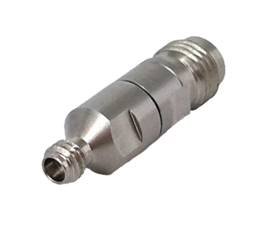
RA18N19YSH02 joins N female to SMA female, a single bulkhead body rated to 18 GHz at 50 ohms. The headline figures are a VSWR of 1.15:1 maximum and an insertion loss of 0.17 dB, all specified across the full DC to 18 GHz band rather than at spot frequencies. With a socket at each end, this part mates two male connectors, which is what a cable-to-cable run needs. One-piece construction is the point: every extra mating plane is another reflection, and this part replaces a stack of them with a single joint. The bulkhead body passes through the panel and locks from the inside, so the port has a mechanical anchor instead of a cable hanging on a connector. It is built in the Ultra tier, the tightest tolerance class of this interface family, intended for daily precision work.
Specifications
- Interface A: N female
- Interface B: SMA female
- Frequency: DC to 18 GHz
- Impedance: 50 ohm
- VSWR: 1.15:1 maximum
- Insertion loss: 0.17 dB maximum
- Body: stainless steel
- Centre contact: gold-plated beryllium copper centre contact
- Body style: Bulkhead
- Weight: 0.03 kg
- Grade: Ultra
Where it is used
Test racks use it to bring a device under test onto an analyser without rebuilding the cable run for every new product. It also earns its place in system integration, where two sub-assemblies with different connectors have to be joined without a custom cable.
Because both ends are industry-standard interfaces, nothing else in the set-up has to change: the existing cables, the existing calibration kit and the existing fixtures all still apply.
DC to 18 GHz covers most laboratory traffic, from baseband through the lower microwave bands, and it is the range where this interface family has the deepest catalogue.
Compatibility and mating
It mates with standard SMA interfaces. The threaded coupling needs about 0.8 to 1.1 N·m; hand-tight plus a short wrench is enough, and overtightening is what deforms the dielectric and shifts the match.
Each end keeps its own interface standard, which is why the part number lists both series rather than a single connector type.
Do not use the body as a lever. Side load on a connected cable is what bends centre pins and opens the match.
Ordering
Order by the part number as listed: the code encodes the interface pair, the gender at each end and the body style, so a different suffix is a different part rather than a variant of this one.
Frequently asked questions
Does an adapter add loss?
Yes, a small amount. The datasheet gives the maximum insertion loss for this part; at these frequencies it is usually a few tenths of a dB, but it belongs in the budget.
Can I mate it with a different precision series?
Only where the standards are mechanically compatible. SMA, 3.5mm and 2.92mm intermate; 2.4mm and 1.85mm intermate; mixing across those two groups damages the precision side.
Can I use it the other way round?
Mechanically the adapter is symmetric only if both ends are the same sex. With a male/female pair the direction is fixed by the genders, so match the male end to the female port.
Will it degrade my VSWR?
Every interface adds a reflection. The guaranteed maximum is in the specifications above, and a good adapter typically measures better than its limit on a calibrated analyser.
Why does the price differ from a standard adapter?
Precision tiers hold tighter tolerances and use better materials and plating, which costs more to machine and to test. The tier is part of the part number, not an option.




Reviews
There are no reviews yet.